On Caste based Reservations and Diversity Hiring
A shift of perspective on caste based reservations and popular opinion on diversity hiring and alimony
A few years ago, and until recently, I was a devout believer in meritocracy, the idea that people should be selected according to merit. I’ve always hated the concept of someone taking away my years of hard work just by being born into a specific caste, community, or even being a woman, that is, through reserved seats. Being put through two years of rigorous study to achieve competence over 92% of the people, and then watching a random person get what I wanted with just a bit over half of what I scored, is truly disheartening. For three years, I held the notion that I had been robbed of what I deserved. The most deserving person is the one who stands out the most in talent and hard work. I thought so.
A couple of months back, I was introduced to the story of Surekha Bhotmange, an Indian woman, and for the record, she wasn’t poor. She was married and was more educated than her husband, implying that she functioned as the head of her family. Surekha and her husband had bought a small plot of land in the village of Khairlanji in the state of Maharashtra. It is trivial to mention, but crucial to the story, that Surekha was a Dalit. Without that identity, her story cannot unfold. The land was surrounded by other farms belonging to people of her village — people who called themselves “upper caste.” The panchayat of their village didn’t allow them to get electricity, rebuild their house, or even irrigate their land. The villagers tried to build a road through her land, and when she protested, they drove bullocks into her field. When Surekha sought help from the police, it was overlooked. Eventually, the villagers attacked one of her relatives and left him to die.
The police had to intervene now, and a few people were arrested. But surely, they were released almost immediately. That night, over seventy men gathered around Surekha’s house while her husband wasn’t home. They burnt the house and dragged Surekha and her daughter out. The boys (her two sons) were ordered to rape their mother and sister. When they refused, their genitals were mutilated, and eventually, they were lynched. Surekha and Priyanka were gang-raped and beaten to death. Their bodies were dumped in a nearby canal, where they were found the next day.
After learning about this, I couldn’t wait to know if her death received any form of justice. But as you’d expect, the court denied that it was a caste offense. (If it’s denied, the punishment can be reduced or commuted — this is common in India, even in cases of rape.) Caste-based violence isn’t uncommon. Castes like the Mahars, Mangs, and Chambhars were once forced to tie a broom made of reeds or twigs to their waist whenever they entered or passed through upper-caste areas or public spaces, so they wouldn’t pollute the Brahmin’s soil. Some were made to tie pots to their necks so they would spit into them instead of onto the “pure” land.
None of this is justified — not at all. We feel very sorry for these people, and yes, it is not easy to survive as a lower-caste person in India. This social boycott has been going on for millennia (over 2,000 years), generation after generation, with no right to education or any form of social liberty.
Upper castes considered themselves pure and the Dalits impure, so they justified the forced lynching and rape of Dalit women by claiming, “They’re already impure, so they can be used as sex objects.” If a child was born out of these acts, both the mother and the child would be considered even more polluting and would be socially abandoned. Their existence is as real as the existence of reservation.
Let me put the numbers to give a clearer overview. Brahmins form no more than 3.5% of the population of our country, yet today more than 70% of IAS officers are Brahmins . Much of India’s wealth is dominated by the upper castes, while OBCs with SC/STs constitute nearly 70% of the population. About 92% of workers cleaning urban sewers and septic tanks are from SC, ST, and OBC groups. Here’s what the World Inequality Report has to show on wealth distribution by caste:
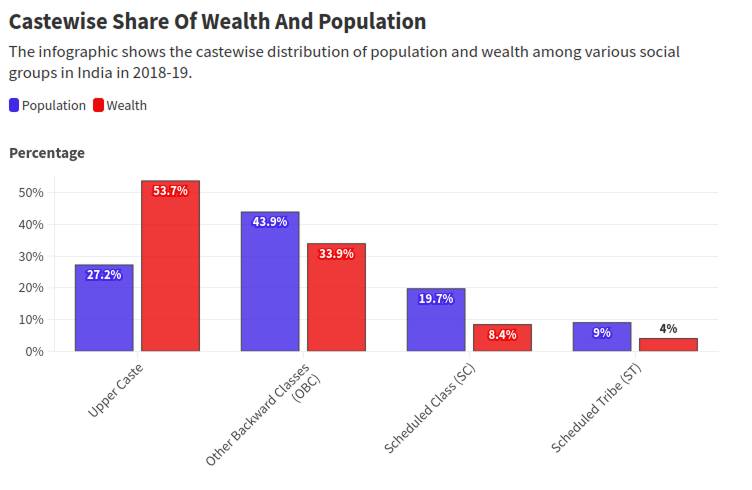
It disturbed me to the core. How can 92% of sewage cleaners be from lower castes? That number still haunts me. It’s apparent that education was only for the upper castes, while cleaning and other presumed “lowly” jobs were for the Shudras or Bahujans. Every generation of these people was forced into these occupations, and if they attempted anything else, they were socially abandoned. We don’t realize how inhumane social abandonment is. You’re constantly reminded that you’re impure, not human. You have no access to education, can’t touch people, can’t walk freely, can’t have a good house, and sometimes, can’t even drink water. How inhumane indeed.
Caste isn’t limited to hindu society, South-asian Muslims adopt this with their own hierarchy. I’ve met countless Muslims who take pride in being the Syeds, asserting that they’re above all others. They use derogatory terms such as Dhed to refer Dalits. Even in my own vicinity, I’ve seen caste pride and lowly perception of the Noorbash and Laddaf communities.
The case with women in India isn’t any different, irrespective of caste. In my own section of college, the male-to-female ratio is about 4:1. This statistic doesn’t change much when it comes to gender distribution in workplaces. You might see that women’s education is improving rapidly, but the truth is, this education is often seen merely as an investment, an investment in finding a matching partner and marrying them off to a suitable man who is well-educated. The majority of women are married off early, forced to bear children, and confined to raising them.
While social abandonment might not apply to women as it does to Dalits, the reality is that women are still confined to homes, even when highly educated. It isn’t easy for a woman to get a fair education, and even more difficult to continue working as long and as freely as a man does. This is why alimony exists, when a woman drops her opportunity to work to serve as a housewife, which is common in most marriages, she is logically entitled to have some share after the divorce to balance her needs. Sadly, the extremist Men’s rights activists groups treat exceptions as common misuse of the law and attack the law of alimony.
All of this context is required to define one term: social freedom. How much social (not economical) freedom does a Dalit or a Woman have in Indian Society? Does the society allow them to grow even if they have the resources?
So when I ask whether an SC/ST person competing alongside me in an exam or for a job has the same “social freedom” as I do, I don’t have an answer.
In the end, I leave this question to the reader: Should SC/ST and OBC lower-caste individuals, who dominate sewage and septic tank cleaning due to centuries of caste oppression, who lack adequate social representation despite not being a numerical minority, and who are often barred from competing fairly in examinations, receive some concession in their performance? Similarly, shouldn’t a girl who studied under candlelight in a family that denied her education receive consideration in an exam, while a middle-class boy, facing no such restrictions, easily scores higher?
I think when you remove reservation or diversity hiring, the system favors this generational nepotism in education and employment. The upper castes’ previous generations are doctors, engineers and government servants, while the few that belong to the lower castes are first generation employees/students. constantly reminded that they haven’t come here because of their talent and hardwork but through reservation, well, how ironic, the reason they are lacking behind is centuries of oppression.
Castiesm is so normalized that a specific community’s name is being used as a slur. The term “Chapri” has origins in Marathi, Kannada, and Hindi words, deriving from “chappar” or roof. Additionally, the term is associated with the Chapparband caste. What starts off as an occupational reference becomes a caste-coded slur today.
Due to immense caste discrimination the Dalits choose to convert to other religions expecting that they might be treated well in their communities. Little do they know, when men want to be in power, scriptures become divine law and tools of oppression. Still, the current society cusses the converts as rice bag converts if they convert to christianity. When women are lynched or forced to parade naked in villages, and when Dalits are killed, no journalism calls it terrorism. But when movies reflecting the story of Kashmiri Pandits are released, they get massive appreciation and national awards. Meanwhile, when movies like Phule appear, no amount of publicity can help promote them in the media. When movies like Homebound or Dhadak 2 show up, there isn’t much appreciation for showing the truth. Why is this truth biased? Isn’t oppression, killing, and rape of lower-caste people terrorism?
Terrorism is defined as the unlawful use of violence and intimidation, especially against civilians, in pursuit of political aims. Much of the caste-based system is precisely that — violence used to maintain a social hierarchy. I’d even go further and say that social abandonment is more inhumane; it tortures people both physically and mentally throughout their lives, and some find peace only in death. Casteism is domestic terror. What makes it more insidious is that it’s normalized, absorbed into everyday life, and even moralized through religion. The fact that casteism persists even among educated, wealthy Indians (as shown in those 2025 comments on a 2007 documentary) proves that economic mobility alone doesn’t erase these deep social divisions. This is why representation matters — not just economically, but in positions of power and visibility.
Personal Notes
I have openly stated before that reservation or diversity hiring is unequal and cannot be justified. So, I am entitled to correct my views. The truth is, I don’t have an answer for what is truly justified. These considerations exist for a reason, and I am not sure what other system could bring women, Dalits, and other underrepresented groups justice.
I see, even in my own surroundings, that caste is practiced and women are restricted. This essay isn’t just about caste-based reservation, it’s about every individual whose freedom is limited. Be it an Afghan Muslim girl or a Dalit, this essay is an acknowledgment of those who fight against social systems to prove that they are capable and not biologically limited in intellect or strength.
As I read once, Caste doesn’t exist for the upper caste. Class doesn’t exist for the upper class. Patriarchy doesn’t exist for men. Race doesn’t exist for the white. In a nutshell, what you don’t experience doesn’t exist.
Some of us need to understand the social privilege and know that many of our achievements that we call as merit is partly due to the accident of birth and the privileges that came with it.
Privilege is something that is often invisible to those who have it.